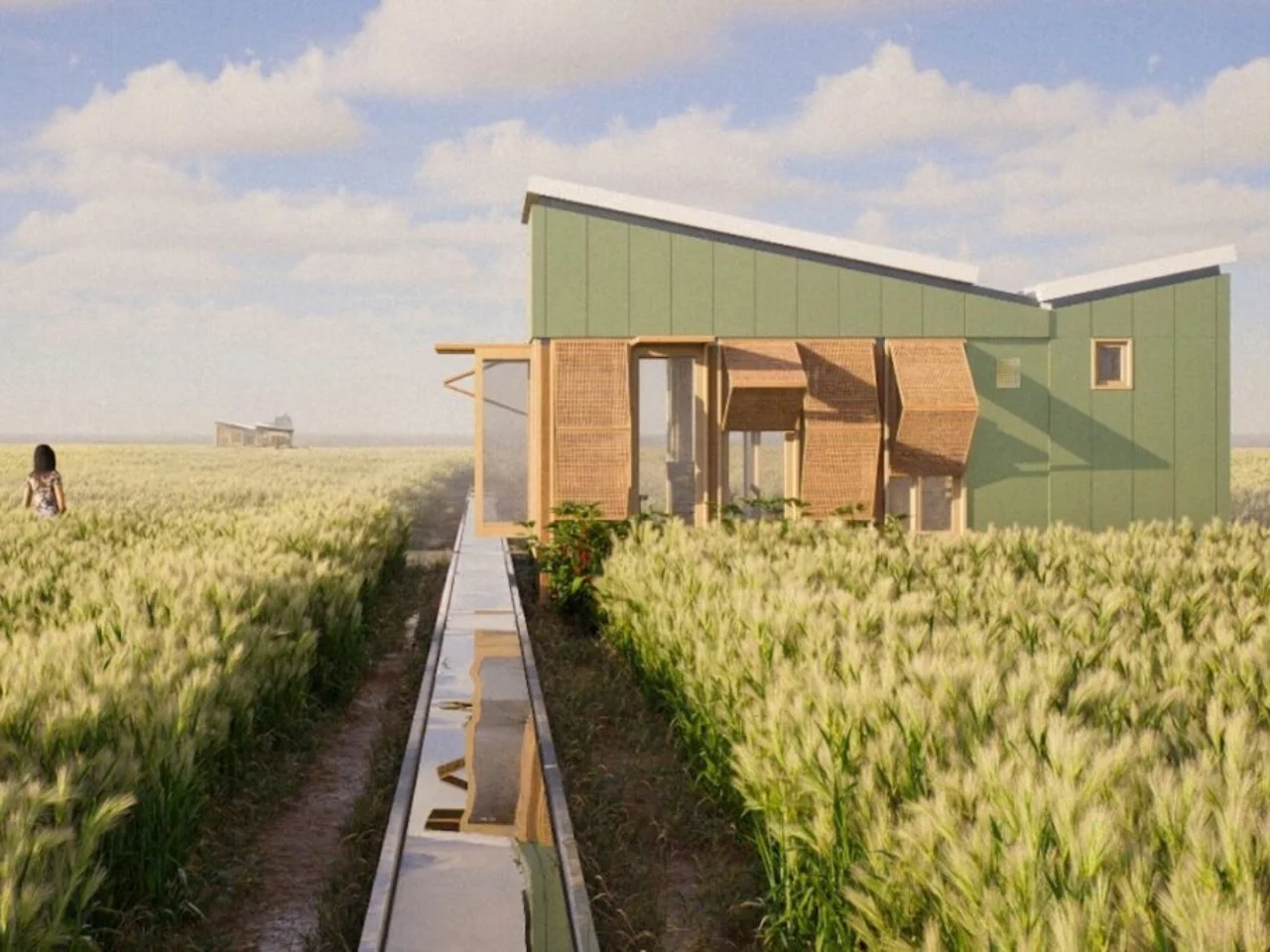
In an era where climate change, water scarcity, and housing shortages are converging into a global crisis, architects are reimagining what homes can be and do. One of the most forward‑thinking responses comes in the form of “Living on Groundwater” — a tiny home concept that doesn’t just use resources responsibly but actually gives water back to the environment while you live inside.
A New Paradigm in Sustainable Living
Designed by New York–based architects Aleksa Milojevic and Matthew W Wilde, Living on Groundwater is a 25 m² prefabricated microhome that won first prize in the MICROHOME #10 competition, funded by Kingspan and organized by Buildner. Rather than treating water management as an add‑on, this tiny house makes it a core function of its design — transforming a small dwelling into an active instrument of ecological repair.
The project was developed in direct response to real‑world environmental pressures, specifically the severe groundwater depletion affecting regions like Punjab, India. This context — where intensive agriculture has drained aquifers and made water scarcity a daily threat — shaped every aspect of the design.
Not Just a Home — a Hydro‑Positive System
What sets Living on Groundwater apart from typical sustainable homes is its hydro‑positive performance: it aims to return more water to the ground than it consumes.
How It Works
The dwelling integrates a series of interconnected systems that manage water intelligently and purposefully:
- Rainwater Harvesting: The home’s roof and façade capture rain, directing it into an on‑site storage and treatment system.
- Greywater Recycling: Water used for showering, washing, and other daily activities is filtered and reused, reducing overall consumption.
- Aquifer Injection Well: Surplus treated water isn’t wasted — it’s injected directly back into the aquifer through a dedicated well onsite, actively replenishing groundwater.
This combination moves beyond traditional sustainability measures like low consumption and passive design. Living on Groundwater positions its residents as active stewards of the local water cycle — a radical shift in how architecture interacts with ecosystem processes.
Design That Respects the Land
To support these environmental goals, the architecture itself was carefully considered:
- Elevated Structure: The microhome sits on a raised timber frame, minimizing ground disturbance and allowing water, air, and vegetation to move freely underneath — a crucial detail for site ecology.
- Permeable Façade: Instead of tight, sealed walls, the building uses a light‑modulating permeable exterior that balances ventilation, daylight, and connection to the landscape.
- Flexible Interior: The compact living space includes a lofted sleeping area, modular storage, and convertible surfaces that adapt to multiple functions without wasting valuable square footage.
These design choices show that Living on Groundwater isn’t simply about adding environmental tech — it’s about reframing the house itself as infrastructure that functions within and contributes to the natural systems around it.
Beyond Sustainability: Ecology and Community
The project’s significance also lies in its contextual grounding. The architects conducted research, including field studies in Punjab, to understand the cultural and environmental dynamics of regions facing real water stress. This work allowed them to design a system that is not only technically impressive but truly relevant to the lived reality of its potential occupants.
Rather than proposing a one‑size‑fits‑all solution, the microhome’s systems and spatial organization are adaptable — meaning the concept could be scaled or adapted for similar semi‑rural and rural contexts around the world where groundwater depletion is a pressing challenge.
Why the Design Community Took Notice
Living on Groundwater earned its award not just for its clever integration of technologies but for the clarity and coherence with which these systems were woven into everyday life. The international jury praised the project for its:
- Technical sophistication — seamlessly linking rainwater capture, reuse, and aquifer recharge.
- Ecological relevance — positioning habitation as part of a broader hydrological system rather than an isolated structure.
- Combining environmental performance with livability — proving a tiny home can be both comfortable and impact‑positive.
The competition itself is designed to push the boundaries of what compact living can mean, and this project exemplifies that ambition: architecture that isn’t merely “less bad” but actively good for the environment.
A Vision for the Future of Housing
As cities expand and climate pressures grow, housing models must evolve to meet not only human needs but also environmental imperatives. Living on Groundwater offers a hopeful prototype for this future — an elegant, small‑scale dwelling that is nonetheless deeply involved in ecological regeneration.
Designs like this challenge the assumption that homes must draw from finite resources. Instead, they demonstrate that — with intentional design — our living spaces can become active partners in healing the landscapes they occupy. This isn’t just about sustainable design; it’s about responsible stewardship of the planet in a time when every drop of water matters.
What It Means for Architecture and Beyond
Living on Groundwater points toward several broader trends in architecture and sustainability:
- Homes as environmental agents — not passive shelters, but active participants in water, carbon, and energy cycles.
- Context‑driven design — solutions grounded in local environmental realities rather than generic “green” aesthetics.
- Scalable prefabrication — systems that can be replicated efficiently in many places facing similar ecological challenges.
In doing so, this microhome is more than an architectural curiosity — it is a blueprint for resilience in the face of climate change and resource scarcity. It reminds us that the future of housing will hinge not only on how we build, but on how we reconnect homes to the systems that sustain life.