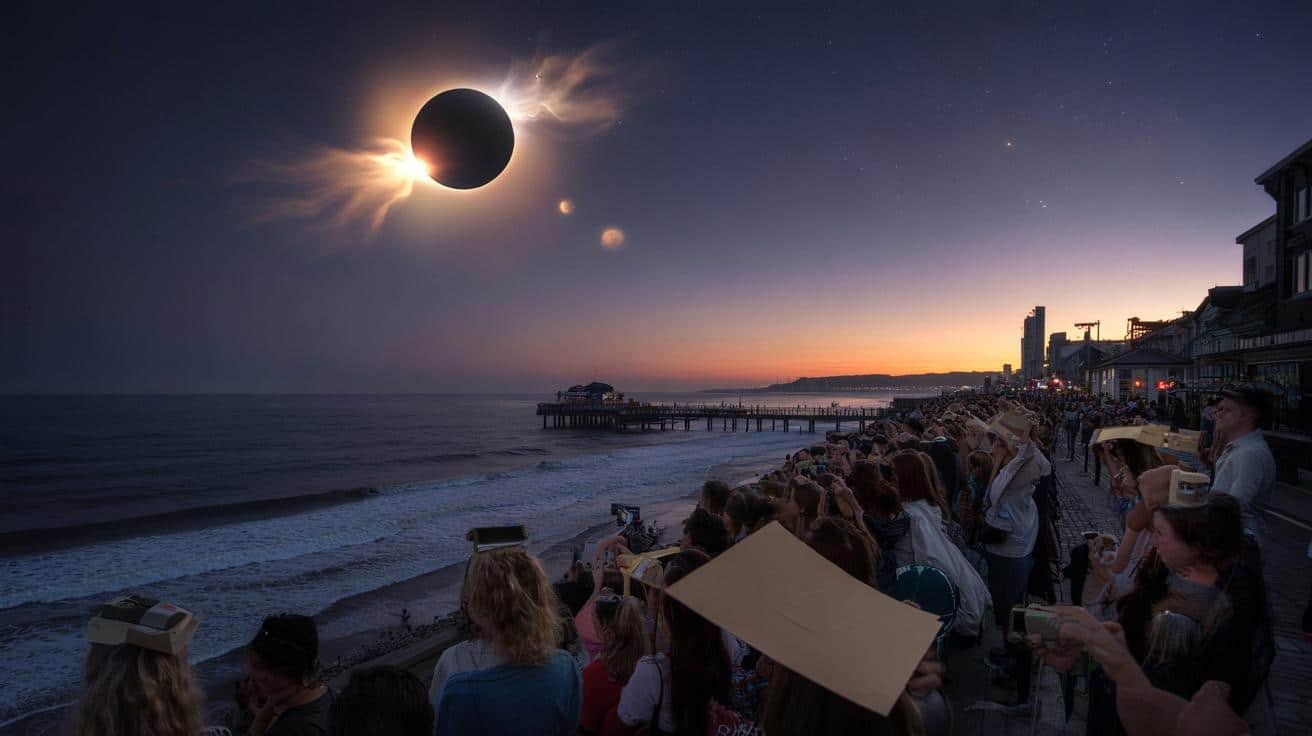
The first sign that something strange is coming is not darkness.
It’s silence.
Standing in a field on the edge of a small town, you notice birds cutting their songs short, dogs tilting their heads toward a sun that suddenly feels… wrong. The light goes flat, colors drain a little from the world, and the heat on your skin drops just enough for goosebumps to rise. Neighbors drift outside, phones in hand, those awkward paper eclipse glasses hanging loose around their necks.
Someone laughs too loudly, someone else whispers, as if afraid to disturb whatever is about to happen in the sky.
Then the moon’s shadow begins to slide across the sun, and the day itself seems to hesitate.
You realise you’re about to watch the longest total solar eclipse of the century.
And there’s no pause button.
When day forgets how to be day
The path of this eclipse slices across towns, deserts, and seas, turning late morning into an eerie, slow-motion twilight.
It’s not instant, like switching off a light, but a thickening dimness that creeps over streets and kitchens and playgrounds.
Children will tug on sleeves and ask why the sun looks “broken.” Offices will empty, traffic will slow, and countless people who never glance up from their screens will suddenly stare at the sky, squinting behind awkward cardboard glasses.
For a few precious minutes, millions of strangers across different countries will be united by the exact same silence, under the exact same shadow.
That alone is a kind of miracle.
In one coastal city along the path of totality, scientists are already rehearsing the countdown like it’s a rocket launch.
Tripods are lined up on the pier, cables taped down, laptops ready to grab data from the very first flicker of the corona.
Nearby, a bar has redesigned its menu for the day: “Shadow Spritz,” “Moon’s Edge Martini,” “Totality Tacos.” The owner expects the biggest lunchtime rush in years. A school just inland has planned a “shadow recess,” handing out homemade pinhole viewers and turning the parking lot into a small festival.
This is the hidden life of an eclipse: part laboratory, part street party, part shared gasp at the sky.
A rare cosmic event turned into a very human day off.
Scientifically, this long eclipse is a perfect storm of geometry and timing.
The moon is close enough in its orbit to appear larger than usual, and the Earth, sun, and moon line up so precisely that the shadow lingers longer than we’ll see again this century.
For astronomers, that extended darkness is pure gold. The sun’s outer atmosphere, the corona, becomes visible, revealing delicate white streamers and fiery loops that can tell researchers how solar storms build and explode.
Those storms can disrupt satellites, power grids, even the GPS that quietly guides planes and delivery trucks.
So while people on the ground stare up in awe, teams in observatories and labs will be working flat-out, chasing fleeting data that could help protect our very wired, very fragile modern life.
The sky goes dark, and the spreadsheets light up.
How to watch the eclipse without wrecking your eyes
The simplest ritual of this day starts with one small object: safe eclipse glasses.
They look flimsy, like a party favor, but they carry the single rule that separates wonder from real damage.
Real eclipse glasses carry an ISO 12312-2 certification and block out all the dangerous ultraviolet and most visible light, letting you watch the sun as a pale, ghostly disc. You slip them on well before the first bite of the moon appears and keep them on every time any part of the sun is exposed.
Only during the brief phase of totality, when the sun is fully covered and the corona blooms out like a white crown, can you remove them and look with bare eyes.
And the moment the first bright bead of sunlight returns, they go straight back on.
On every eclipse day, emergency rooms see the same avoidable mistakes.
People glance up just “for a second,” or watch through regular sunglasses, or stack three pairs like that somehow makes them safe. It doesn’t.
Retinal burns don’t hurt right away. Vision can feel normal at first, then blur hours later, with spots or permanent damage that no doctor can reverse. That’s a brutal price for ten careless seconds.
*Let’s be honest: nobody really reads the safety flyer all the way through, even when they probably should.*
So if you’re the cautious one in your group, don’t feel silly repeating the warning.
That one boring sentence from you could be the thing someone remembers at the exact second they start to look up.
For those who want more than just a quick look, there are simple ways to turn eclipse day into a small, homemade observatory.
A cardboard box with a tiny hole can project the sun’s changing shape onto a sheet of white paper, letting kids “watch” the eclipse without ever aiming their eyes at the sky.
“Every eclipse has two stories,” says Dr. Lina Morales, a solar physicist coordinating a network of citizen observers. “There’s the story happening in the sun’s atmosphere, and there’s the story happening in people’s backyards, on their balconies, in schoolyards. We need both.”
- Use certified eclipse glasses or a proper solar filter on cameras and telescopes.
- Turn your back to the sun and use a pinhole projector for children or groups.
- Don’t look through binoculars or a camera viewfinder without a solar filter.
- Watch pets and young kids, who may copy adults and glance up.
- Plan your viewing spot early; totality doesn’t wait for traffic jams.
The kind of shadow that stays with you
Long after the last sliver of shadow slips away and the sun returns to its usual, almost boring brightness, people will still be replaying those strange minutes in their heads.
Not the science, not the numbers, but the feeling of watching daylight fail in slow motion, together.
Someone will remember the neighbor who cried when the stars popped out at noon.
Someone else will remember how the temperature dropped and the wind shifted, as if the world was briefly exhaling. Another person will remember missing it entirely because a meeting “ran long,” and feel a small, private regret they hadn’t expected.
These events have a way of rearranging our inner scales of what counts as urgent.
Emails lose to shadows. Deadlines lose to the sky.
There’s also the simple, humbling fact that this eclipse is the longest total one we’ll see this century.
Most of us will not be around for the next comparable show. That awareness sits quietly in the background of the countdown, giving the whole day a sharper edge.
Some will travel across continents for a few extra seconds of totality. Others will just step out onto a balcony or a parking lot and tilt their heads back for the first time in months. **Both experiences are valid, both are real.**
The plain truth is: the sun and moon will do their careful dance whether we show up to watch or not.
But when we do, something in us tends to recalibrate.
Scientists will publish their papers, crunching what the corona revealed about magnetic fields, solar flares, and racing plasma.
Tourism boards will count hotel bookings and restaurant bills, measuring the economic bump that arrived on the back of a moving shadow.
Yet the deeper value of this long eclipse might land somewhere softer. In the conversations it sparks between generations, in the way kids ask bigger questions that don’t fit neatly into homework assignments, in the way adults admit they felt small and oddly comforted all at once.
**A total solar eclipse is one of the few times our hyper-connected world collectively looks up instead of down.**
When day slowly becomes night and then returns, we’re reminded that our daily dramas unfold on a planet that’s literally passing through shadows.
That thought has a way of lingering, long after the sun is whole again.
| Key point | Detail | Value for the reader |
|---|---|---|
| Longest total eclipse of the century | Extended totality offers more time in the moon’s shadow than any other eclipse this century | Gives a rare chance to experience deep daytime darkness and plan a once‑in‑a‑lifetime trip |
| Safety and viewing methods | ISO-certified eclipse glasses, pinhole projectors, and basic observing setups | Protects eyesight while allowing you, your family, or students to enjoy the spectacle fully |
| Scientific and emotional impact | Solar corona research, space-weather insights, and a collective sense of awe | Helps you grasp why this event matters both to researchers and to ordinary people watching the sky |