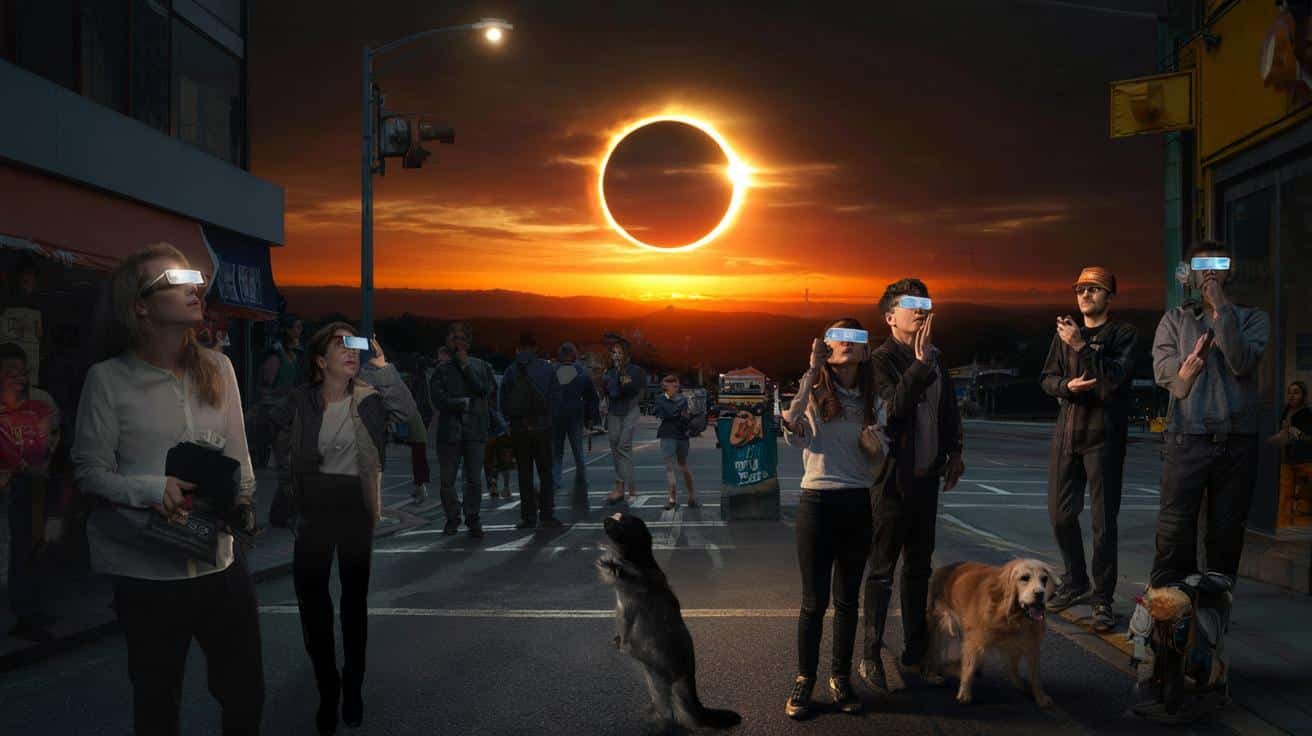
The first sign isn’t darkness. It’s silence.
Birds stop mid-song, as if someone hit pause on the sky. The dog two houses down, the one that barks at every passing leaf, suddenly lowers its head and whines. On the street, people step out of offices and coffee shops with cardboard glasses pressed to their faces, like a strange, silent parade.
Then the light begins to thin. Shadows go razor-sharp. Colors look slightly wrong, as if the world had slipped into a different filter you never chose. Someone whispers, “Is this really happening?”
Experts say the sun will vanish in the middle of the day, and for a few long minutes, daylight itself will be switched off.
Nobody is ready for how that feels.
When the sun simply… disappears
Astronomers are warning that an extraordinary solar eclipse is officially on its way, the kind of event people cross continents to witness. During those brief minutes, the moon will slide perfectly in front of the sun and daylight will collapse into an eerie twilight. Streetlights may flicker on, temperatures will drop, and the horizon will glow like a 360-degree sunset.
For a little while, the world will look like a movie scene you’re not sure you agreed to be in.
This is not just another “nice to see if you have time” event. It’s a once-in-years alignment where **light itself will disappear**.
Ask anyone who stood under totality during a past eclipse and they rarely talk about the science first. They talk about the feeling.
In 2017, in a tiny town in Wyoming, locals watched the moon swallow the sun while traffic backed up for kilometers. A woman in her thirties burst into tears just as the last bead of sunlight vanished, later saying she “felt the universe breathing.” Construction workers put down their drills. A teenage boy, eyes wide behind his eclipse glasses, whispered to his friend, “Dude, this is like the end of the world… but kind of beautiful.”
The data afterward showed something else: temperature drops of several degrees in minutes, animals disoriented, and power grids subtly adjusting to the sudden loss of solar energy.
There is a very practical reason experts sound a little on edge this time. When the sun goes dark, even for minutes, human behavior changes. People crowd roads at the same time. Drivers try to film while steering. Parents scramble to protect kids’ eyes at the last second.
Scientists also warn that our eyesight doesn’t feel pain when it’s being damaged by the sun, even during an eclipse. That creates a dangerous illusion of safety as the sky dims. *Your eyes can be burning while you’re thinking, “This feels fine.”*
On a bigger scale, meteorologists are eager to watch how such a sharp light-switch moment twists winds, clouds, and temperatures above our cities. The sky isn’t the only thing reacting.
How to live those dark minutes without risking your eyes
If you want to experience this eclipse without turning it into a regret story, preparation starts with something simple and unglamorous: certified eclipse glasses. Not sunglasses. Not stacking sunglasses. Real filters with the international standard ISO 12312-2 written on them.
Think of them like seat belts for your retina. You hope nothing goes wrong, but if you skip them, the stakes are permanent.
Experts advise ordering from astronomy shops, science museums, or well-known organizations, then testing them: you should see nothing through them except the sun or a very, very bright light. If you can see your living room lamp clearly, throw them out.
We’ve all been there, that moment when you tell yourself, “I’ll improvise on the day, it’ll be fine.” This is one of those rare cases where winging it is a genuinely bad idea. The most common eclipse mistakes are brutally simple. People glance at the sun “just for a second.” Parents hand kids glasses that are scratched or bent. Someone tries to watch through their phone camera, not realizing the lens is focusing the rays onto their unprotected eyes.
Let’s be honest: nobody really does this every single day.
So an easy move is to set up a tiny ritual the day before: check everyone’s glasses, plan a safe spot to watch, and decide who’s watching the younger children during the key minutes.
Promoted Content
There’s also a calmer, low-tech way to experience the eclipse: don’t look at the sun at all. Use projection.
You can punch a small hole in a piece of cardboard, hold it over another sheet, and watch dozens of tiny crescent suns appear. “The safest eclipse viewers are the ones who never look up,” says one solar physicist half-jokingly, half-seriously.
- Use a pinhole projector: cardboard with a tiny hole, projecting the sun’s image onto the ground or a white sheet.
- Stand under a tree: gaps between leaves act as hundreds of natural pinholes, scattering crescent shapes across the pavement.
- Join an organized event: many schools, observatories, and science centers will have telescopes with proper solar filters set up.
- Protect kids twice: once with real glasses, once with clear rules about not removing them without an adult’s say-so.
- Give yourself time: arrive at your viewing spot early so you’re not fiddling with gear while the sky is changing.
What these few minutes of darkness say about us
There is something disarming about watching the most reliable thing in our lives blink. The sun rises every day, without our permission, without our effort. Then, suddenly, in the middle of an ordinary afternoon, it gives way to a small, silent shadow.
Some people will cheer, others will feel a chill they can’t quite explain. Kids will remember the strange midday night for decades. Astronomers will crunch numbers and refine solar models. Photographers will chase that perfect ring of fire.
Between all of them, a common thought threads quietly through: we are much smaller than we act, most days.
This eclipse will last only minutes in any given place, yet whole cities are already adjusting around it. Schools are sending out emails. Airlines are eyeing flight paths that might catch the shadow. Emergency services are planning for drivers staring at the sky instead of the road.
The light will go, and then it will come back, as it always does.
But those who stand outside and feel the temperature drop on their skin, who hear the sudden hush in the trees, often walk away changed in a way that’s hard to quote or measure. They’ve seen the machinery behind the everyday.
Maybe that’s why eclipses trigger such a mixed rush of emotions: awe, anxiety, curiosity, a twinge of fear. They remind us how much of our life depends on things we never think about. The precise tilt of a planet. The fragile clarity of human eyesight. The idea that midday can turn almost to night because two enormous bodies happen to line up, right where we live.
This time, experts are telling us quite bluntly: the light will disappear for minutes. Not as a metaphor, but as a scheduled, predictable event.
What we choose to do in those minutes — watch, hide, film, share, simply breathe — will say a lot about who we are in the face of a sky that doesn’t belong to us.
| Key point | Detail | Value for the reader |
|---|---|---|
| Safe viewing | Use ISO 12312-2 certified eclipse glasses or projection methods | Protects eyesight from permanent damage while still enjoying the show |
| Emotional impact | Rapid darkness, temperature drop, and animal reactions can feel unsettling | Helps you prepare mentally and explain the experience to children |
| Planning ahead | Choose a viewing spot, arrive early, check gear the day before | Reduces stress, distractions, and last-minute risky shortcuts |
FAQ:
- Question 1Can I look at the eclipse with regular sunglasses?
- Question 2How long will the light disappear in my area?
- Question 3Is it safe for children and pets to be outside?
- Question 4Will the eclipse affect power, phones, or the internet?
- Question 5What if it’s cloudy on the day of the eclipse?