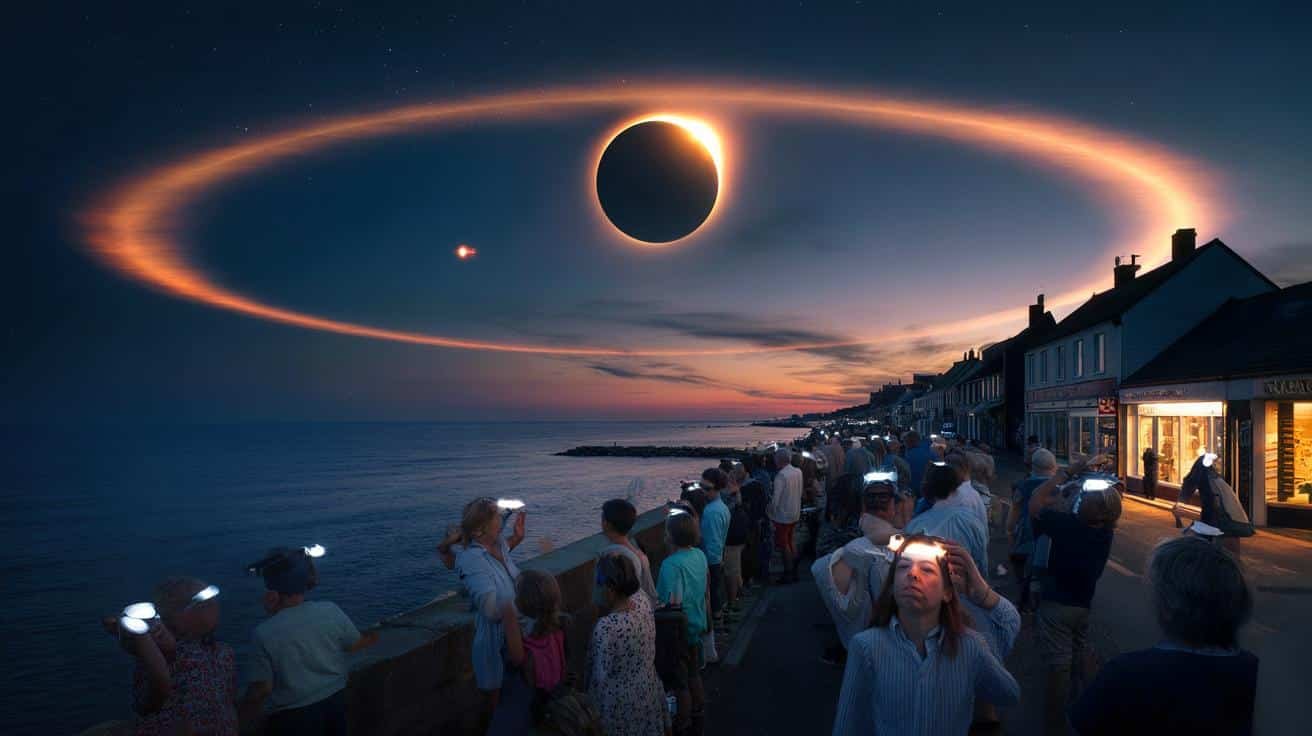
The first thing most people notice is the birds.
They go quiet, one by one, as if someone is slowly turning down the volume on the day. On the street corners, people step out of shops, holding flimsy cardboard glasses to their faces, half excited, half unsure. The sunlight goes from warm yellow to a weird, metallic gray, like a movie scene losing its color. Car headlights flick on without anyone really thinking about it.
Then, suddenly, the air feels colder on your skin. Shadows sharpen, stretching long and thin. Someone whispers “Wow” under their breath, and a hundred faces tilt to the dimmed sky at once.
Day is still here. But it’s slipping.
And this time, it will be the longest total solar eclipse of the century.
The day the sky forgets the time
Across several regions on the planet, people will live through a noon that feels like midnight. The Moon’s shadow will sweep slowly across Earth, turning day to night in an almost languid motion. Not a quick blink, not a fleeting moment, but a long, drawn-out dimming of the world.
Streetlights will flicker on while the hands of your watch still insist it’s afternoon. Dogs may start to bark, while some children will instinctively look for stars. Under that shadow, you can actually see the sky changing color in real time, as if someone is dragging a dimmer switch across the horizon.
Imagine a small coastal town directly under the path of totality. The morning starts bright and normal: fishermen sorting their nets, students scrolling their phones on the way to school, coffee vendors steaming paper cups. Then the light begins to thin, barely noticeable at first. Conversations slow. People check the time, as if their watches could explain the sky.
When totality finally arrives, the sun disappears behind the Moon, and a black disc hangs there, edged with a pale, ghostly crown. For several long minutes, the sea turns steel-blue, stars appear in the middle of the day, and you can hear someone’s heart beating faster just by standing close. Then, almost shyly, the light returns.
This particular eclipse stands out not just because it’s total, but because it will last longer than any other total eclipse this century. The path of the Moon’s shadow, the distance between Earth and Moon, and the exact geometry of their orbits have lined up almost perfectly. That alignment stretches the moment of total darkness, giving millions of people more time under that surreal twilight.
Astronomers have been calculating this event for years, plotting the shadow’s path across continents, oceans, and cities. For local communities, that long corridor of darkness means more than a scientific spectacle. It means crowded rooftops, traffic jams in the “best viewing zones”, and whole schools walking out to playgrounds as the sky goes wrong and right again.
How to actually live this eclipse, not just watch it
The best way to experience a long total solar eclipse is to treat it like a slow ritual, not just a quick selfie moment. Start at least an hour before maximum coverage, when the Moon begins its bite into the Sun. Even with eclipse glasses on, you’ll see the Sun slowly change shape, turning from a round disc into a thick crescent, then a thin one.
Use that time to look around you, not just up. Watch the way shadows on the ground start to look strange and crisp, with tiny crescent shapes appearing under trees. Notice the temperature drop on your arms, the way people’s voices get quieter without agreeing to.
Most people think the only rule is “wear glasses or go blind.” The truth is, the emotional side matters just as much as the safety one. Plan where you’ll be: a rooftop, a quiet field, a crowded town square. Each setting changes the memory you’ll carry. If you’re going with kids, talk beforehand about what they’ll see so they’re amazed, not scared.
Let’s be honest: nobody really reads the full safety leaflet they get with eclipse glasses. So keep it simple. Glasses on anytime the Sun is visible, glasses off only during totality, when the Sun is completely covered and the sky has gone full twilight. Then right back on the second the first diamond of light returns.
During the long minutes of totality, people tend to forget their phones and just stare. “The first time I saw a total eclipse, I stopped trying to photograph it halfway through,” says Lina, a 34‑year‑old engineer who now chases eclipses across continents. “I realized the camera wasn’t big enough to hold what I was feeling.”
- Before the eclipse – Check your viewing spot, your glasses, and the exact time totality starts where you live.
- During partial phases – Use certified eclipse glasses or indirect viewing methods. Talk, observe, breathe. This is the build‑up.
- During totality – Safely look without glasses, watch the Sun’s corona, the stars, the 360° sunset glow around the horizon.
- After the shadow passes – Note how fast normal life rushes back, like someone hit “play” on reality again.
- Later that night – Write a few lines about what you felt. You’ll forget the details faster than you think.
A brief night at noon that lingers in the mind
Long after the last sliver of shadow has slipped off the Earth, people will still be telling stories about “that day when the afternoon turned into night.” These shared anomalies stitch themselves into local memory. The shop owner who closed early. The bus driver who pulled over so passengers could watch. The teacher who let the whole class scream when the sky went dark.
We’ve all been there, that moment when the world reminds you how small your daily worries actually are. An eclipse does that without a single word. *For a few minutes, the universe takes over the schedule.*
This longest total solar eclipse of the century will cross borders without caring about them, painting the same shadow over rich neighborhoods and forgotten villages. Some will livestream it. Some will pray. Some will just squint up and say, “So that’s what everyone was talking about.”
The plain truth is: most of us will go back to emails and errands the next day. Yet a tiny part of the brain will now remember what it feels like when the light disappears slowly, deliberately, and then comes back. And that memory tends to show up again in hard times, as proof that the sky can go dark and still return to blue.
| Key point | Detail | Value for the reader |
|---|---|---|
| Longest total eclipse of the century | Unusually long duration of totality across several regions | More time to observe, feel, and photograph a rare event |
| How to experience it fully | Arrive early, watch the light change, alternate between looking up and around | Turns a short astronomical event into a rich personal memory |
| Safety and emotion | Use proper eclipse glasses, plan your spot, allow yourself to be moved | Protects your eyes while deepening the emotional impact |