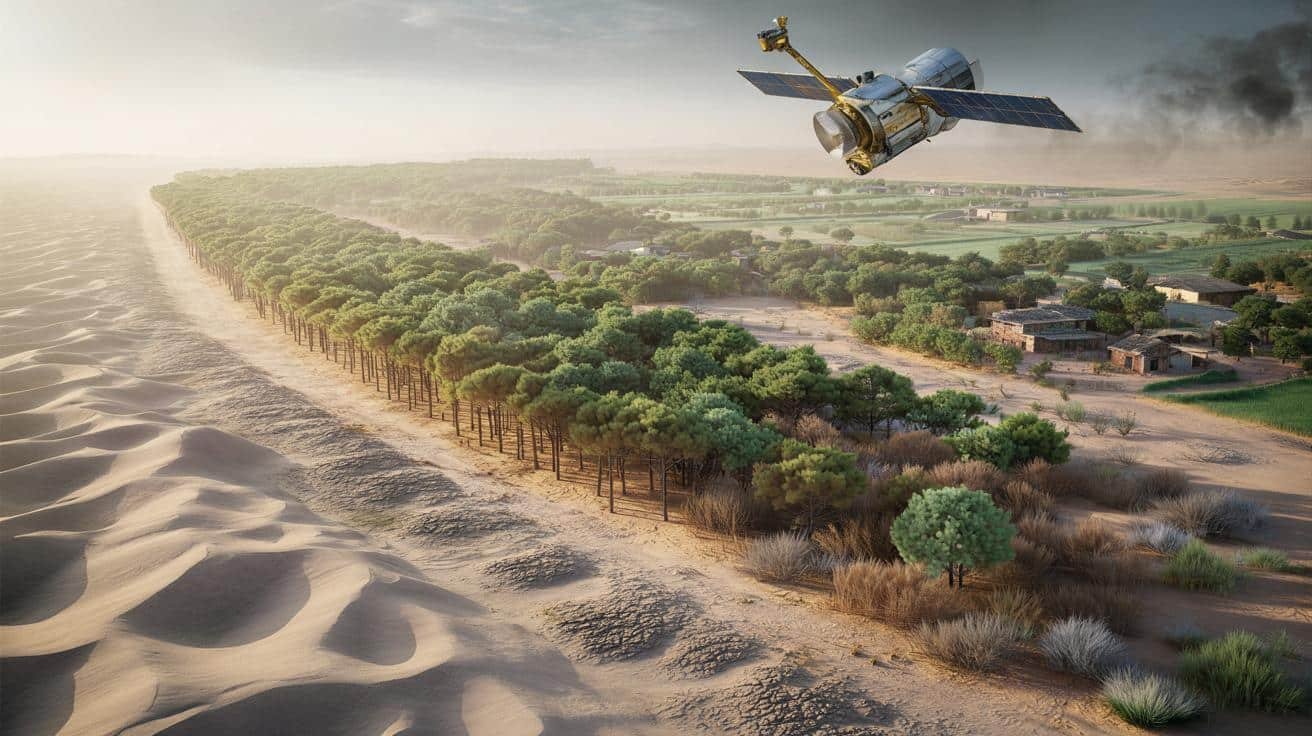
Desertification—land degradation in arid and semi-arid regions—has long posed a serious environmental and socioeconomic threat across the globe. In China, the expansion of the Gobi and Taklamakan deserts has threatened farmlands, water resources, and rural communities for decades. In response, China initiated one of the largest ecological restoration projects in human history: the “Great Green Wall”, officially known as the Three-North Shelter Forest Program. Stretching over 4,500 kilometers across northern China, this ambitious initiative involves planting trees and vegetation to combat desertification, improve soil quality, and reduce dust storms.
Recent findings from NASA satellites have provided compelling evidence that the Great Green Wall is not only slowing the advance of deserts but also reshaping entire regional ecosystems. By combining satellite imagery, vegetation monitoring, and climate data, scientists have quantified the program’s impact, confirming that large-scale ecological restoration can deliver measurable environmental benefits.
The Origins of the Great Green Wall
China’s Great Green Wall was launched in 1978, aiming to create a continuous belt of forests and grasslands across northern China. The program’s objectives include:
- Slowing Desert Expansion: Preventing the Gobi and Taklamakan deserts from encroaching onto agricultural and urban areas.
- Reducing Dust Storms: Stabilizing soil and vegetation to minimize airborne dust that affects health and infrastructure.
- Enhancing Biodiversity: Restoring habitats for native flora and fauna in degraded regions.
- Improving Water and Soil Quality: Planting vegetation that conserves water, reduces erosion, and enriches soil fertility.
Over the decades, the project has planted tens of billions of trees, established shelterbelts, and promoted sustainable land management practices.
NASA Satellite Data and Observations
NASA’s satellites, particularly the Moderate Resolution Imaging Spectroradiometer (MODIS) on the Terra and Aqua satellites, and Landsat imagery, have enabled scientists to monitor vegetation changes across vast areas. Using Normalized Difference Vegetation Index (NDVI) measurements, researchers can track plant growth and quantify the density of green cover over time.
Key findings from NASA’s analysis include:
- Significant Increase in Vegetation: Large portions of northern China show measurable increases in vegetation cover, indicating the success of tree planting and ecological restoration efforts.
- Reduction in Desert Expansion: Areas previously at risk of desertification are experiencing slower rates of soil degradation, demonstrating that the green wall is acting as an effective barrier.
- Improved Regional Climate: Increased vegetation helps retain soil moisture, reduces surface temperatures, and even influences local rainfall patterns, subtly reshaping regional climates.
- Enhanced Carbon Sequestration: Trees and grasslands in the project area are absorbing significant amounts of CO2, contributing to climate change mitigation efforts.
How the Green Wall Works
The success of the Great Green Wall relies on multiple ecological principles:
- Windbreaks and Shelterbelts: Rows of trees act as barriers that reduce wind speed, preventing soil erosion and sand movement into farmland.
- Root Systems for Soil Stabilization: Deep-rooted trees and shrubs anchor the soil, preventing sandstorms and nutrient loss.
- Vegetation Diversity: Planting multiple species, including drought-resistant grasses and shrubs alongside trees, ensures ecological resilience and reduces monoculture risks.
- Water Management: Strategic planting along water catchment areas and irrigation projects ensures that vegetation survives in arid regions.
By addressing both biophysical and climatic factors, the Great Green Wall effectively curtails desertification and promotes long-term sustainability.
Regional Impacts
The positive outcomes of the Great Green Wall extend beyond the immediate planting areas, affecting entire ecosystems and human communities:
- Agricultural Productivity: By reducing desert encroachment, farmland is preserved, supporting local food security and livelihoods.
- Reduced Dust Storms: Northern China and even regions as far away as Beijing have experienced fewer severe dust events, improving air quality and public health.
- Biodiversity Recovery: Restored vegetation provides habitat for native species such as foxes, hares, and a variety of birds, reversing the ecological damage caused by desert expansion.
- Climate Feedbacks: Increased green cover modifies local microclimates, stabilizes temperatures, and helps conserve soil moisture, further reinforcing vegetation growth.
These regional effects demonstrate that large-scale reforestation projects can have cascading benefits, impacting both the environment and society.
Challenges and Lessons Learned
Despite its successes, the Great Green Wall has faced challenges:
- Survival Rates of Trees: Harsh arid conditions make it difficult for some planted trees to survive without ongoing maintenance.
- Water Scarcity: Reforestation requires water, which is limited in northern China. Innovative irrigation and drought-tolerant species are critical.
- Monoculture Risks: Early phases of the program focused heavily on a few tree species, which can reduce biodiversity and increase vulnerability to pests.
- Socioeconomic Considerations: Large-scale planting projects must balance ecological goals with the needs of local communities, ensuring that land use practices remain sustainable.
NASA’s satellite monitoring helps address some of these challenges by providing data on vegetation health, survival rates, and soil conditions, enabling adaptive management strategies.
Global Significance
The Great Green Wall serves as a model for combating desertification worldwide. Its lessons are particularly relevant for:
- Africa: The African Union’s “Great Green Wall” initiative aims to restore degraded lands across the Sahel region, inspired by China’s experience.
- Middle East: Countries facing sandstorm threats and land degradation can adopt similar large-scale afforestation and shelterbelt strategies.
- Climate Change Mitigation: Reforestation projects contribute to carbon sequestration, helping countries meet their climate targets.
NASA’s confirmation of tangible results underscores the importance of science-based monitoring in ensuring the effectiveness of ecological interventions.
The Role of Technology in Monitoring
Without satellite data, it would be difficult to accurately assess the scale and impact of such a massive project. NASA’s satellites offer:
- High-Resolution Vegetation Tracking: NDVI and other remote sensing tools allow precise mapping of green cover changes over time.
- Climate Interaction Analysis: Satellites monitor temperature, soil moisture, and precipitation, linking reforestation efforts to local and regional climate outcomes.
- Long-Term Trend Analysis: Continuous data collection enables the study of ecological restoration impacts over decades.
This technology-driven approach ensures that the Great Green Wall can be managed adaptively, maximizing ecological and social benefits.
Future Outlook
China plans to continue expanding and maintaining the Great Green Wall in the coming decades. Emphasis will likely shift toward:
- Diversifying Species: Planting a mix of native trees, shrubs, and grasses to increase ecological resilience.
- Community Engagement: Involving local farmers and communities to ensure sustainable management.
- Water-Efficient Techniques: Using drip irrigation and drought-resistant plants to reduce water consumption.
- Global Collaboration: Sharing knowledge and best practices with other countries facing desertification.
If these strategies are implemented, the Great Green Wall could serve as a long-term shield against desertification, preserving ecosystems and livelihoods across northern China.
Conclusion
NASA’s satellite data has confirmed what environmentalists and policymakers have long hoped: China’s Great Green Wall is effectively slowing desert expansion and reshaping entire regions. Beyond simply planting trees, the project has restored soil fertility, reduced dust storms, improved biodiversity, and influenced regional climates.
The initiative stands as a powerful example of how large-scale ecological restoration, combined with scientific monitoring and adaptive management, can tackle environmental degradation. It also provides inspiration for other countries grappling with desertification, offering a roadmap for sustainable land management in the face of climate change.
As the Great Green Wall continues to grow, it not only protects communities and ecosystems today but also demonstrates humanity’s capacity to restore and safeguard the planet for future generations.